The rise of remote and hybrid work has transformed how we build trust, communicate, and collaborate. Without the informal hallway chats, shared lunches, and nonverbal cues of physical offices, many teams struggle with misalignment, weakened relationships, and eroded company culture. Yet ancient wisdom offers surprising guidance for navigating this digital landscape. Confucian philosophy, with its emphasis on relationships, ritual propriety, and ethical conduct, provides a timeless framework for fostering meaningful collaboration in virtual environments—turning the challenges of remote work into opportunities for deeper connection and purpose.
Understanding Confucian Thought in Modern Context
Confucianism is often misunderstood as merely a set of rigid hierarchies or outdated etiquette rules. At its core, it’s a philosophy of human relationships and social harmony. Confucius (551–479 BCE) taught that virtue is cultivated through our interactions with others, and that a well-ordered society begins with individuals fulfilling their roles with sincerity and respect. Five key concepts are particularly relevant to remote work:
- Ren (仁) – Often translated as “benevolence” or “humaneness,” it’s the virtue of caring for others and acting with empathy and compassion.
- Li (禮) – Ritual propriety, encompassing not just formal ceremonies but the everyday practices, norms, and behaviors that structure social interactions and express respect.
- Xiao (孝) – Filial piety, extending beyond parent-child relationships to loyalty and care in all hierarchical relationships (e.g., manager-employee, senior-junior).
- Yi (義) – Righteousness or justice; doing what is right and proper, even when it’s difficult or not personally advantageous.
- Zhi (智) – Wisdom or knowledge, particularly the ability to judge situations correctly and act appropriately.
These concepts aren’t relics of ancient courts—they’re practical tools for building trust, clarity, and ethical behavior in any collaborative setting, including digital ones.
Rebuilding Relationships in a Virtual World
The Challenge: Remote work strips away many spontaneous interactions that build rapport. Without coffee machine chats or shared commutes, relationships can feel transactional, leading to misunderstandings and weakened team cohesion.
Confucian Response: Confucius believed that relationships are the foundation of virtue. He emphasized “rectification of names” (正名, zhengming)—the idea that people should live up to the expectations of their roles (friend, leader, colleague) through consistent, sincere action.
Practical Applications:
- Virtual “Li” Practices: Establish digital rituals that replace informal office interactions. Examples:
- Starting meetings with a brief personal check-in (not just “How are you?” but “What’s one thing you’re proud of this week?”)
- Creating dedicated Slack channels for non-work sharing (hobbies, pets, local events)
- Sending handwritten notes or small gifts for work anniversaries or personal milestones
- Intentional Ren Cultivation: Make empathy an explicit practice:
- Leaders modeling vulnerability by sharing their own challenges
- “Perspective-taking” exercises in team meetings (“How might this decision affect someone in a different role/timezone?”)
- Assuming positive intent in asynchronous communication (where tone is easily misread)
- Strengthening Xiao Through Mentorship: Adapt filial piety to mentor-mentee relationships:
- Structured virtual mentorship programs with regular check-ins
- Senior team members hosting optional “office hours” for advice and connection
- Recognizing and rewarding those who help others grow
These aren’t forced fun activities—they’re deliberate efforts to fulfill the Confucian ideal that relationships require ongoing attention and care to thrive.
Ritual (Li) as the Invisible Infrastructure of Remote Teams
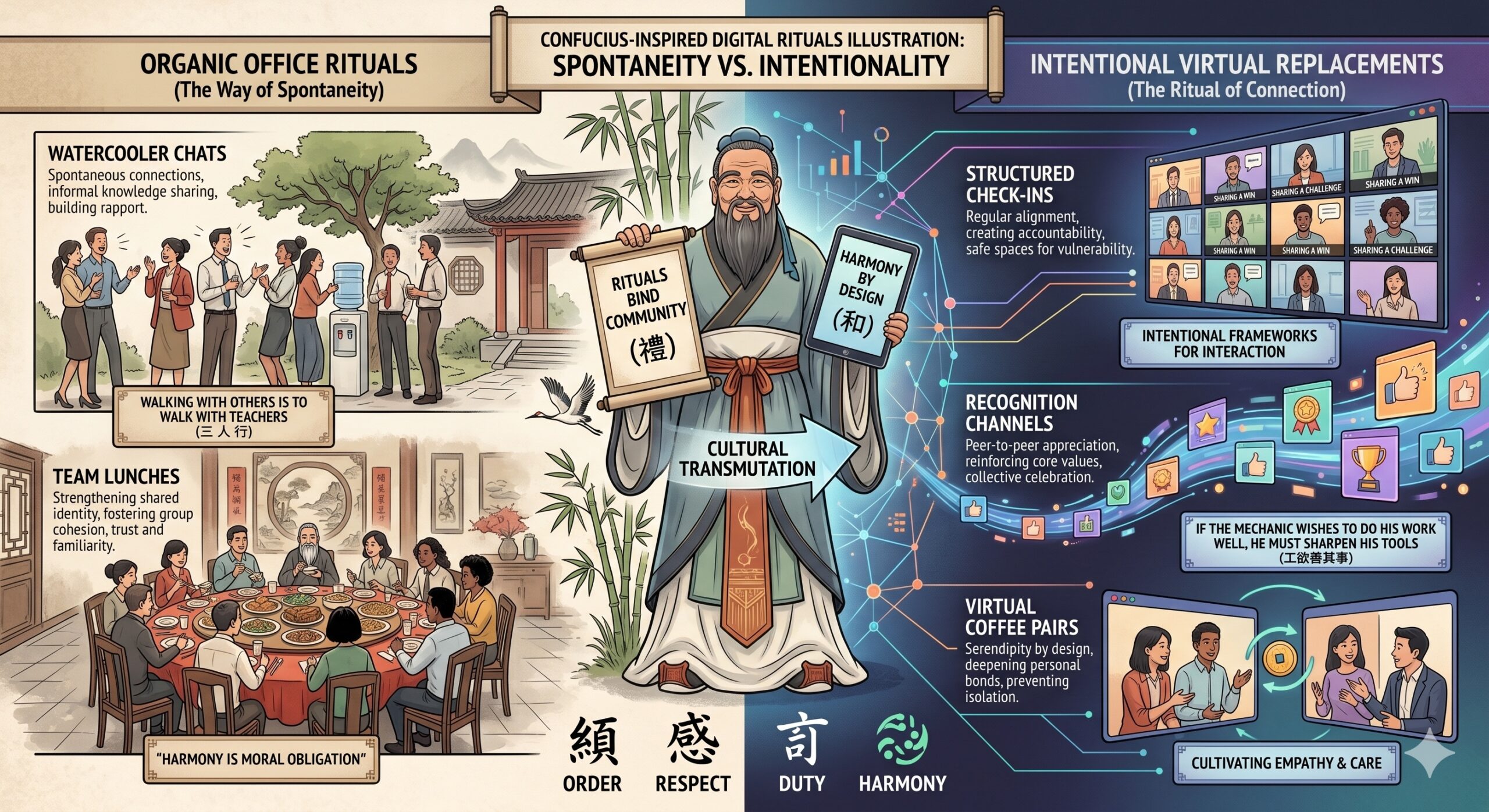
The Challenge: In physical offices, rituals emerge organically: the way meetings start, how decisions are communicated, where people eat lunch. Remote work often leaves these structures undefined, leading to confusion, inefficiency, and perceptions of unfairness.
Confucian Response: Li isn’t about empty ceremony—it’s the meaningful practices that make social life coherent and express mutual respect. Confucius said, “Without feelings of respect, what is there to distinguish men from beasts?” (Analects 3.26). In remote contexts, we must consciously design our digital “li.”
Practical Applications:
- Meeting Rituals: Create consistent patterns that signal respect and focus:
- Beginning with a shared intention or quote
- Using video (when possible) to preserve nonverbal cues
- Having clear protocols for turn-taking and preventing domination by loudest voices
- Ending with explicit action items and who is responsible
- Communication Norms: Define expectations that reduce anxiety and ambiguity:
- Response time guidelines for different channels (e.g., Slack within 4 hours, email within 1 business day)
- When to use video vs. audio vs. text for different types of conversations
- Standards for writing clear, action-oriented messages
- Recognition and Appreciation: Build rituals that acknowledge contributions:
- Virtual “shout-out” segments in team meetings
- Digital kudos boards or recognition systems
- Managers taking time to write personalized appreciation notes
When these rituals are co-created and consistently practiced, they become the invisible infrastructure that makes remote collaboration feel stable and respectful.
Ethical Collaboration: Yi and Zhi in Digital Decision-Making
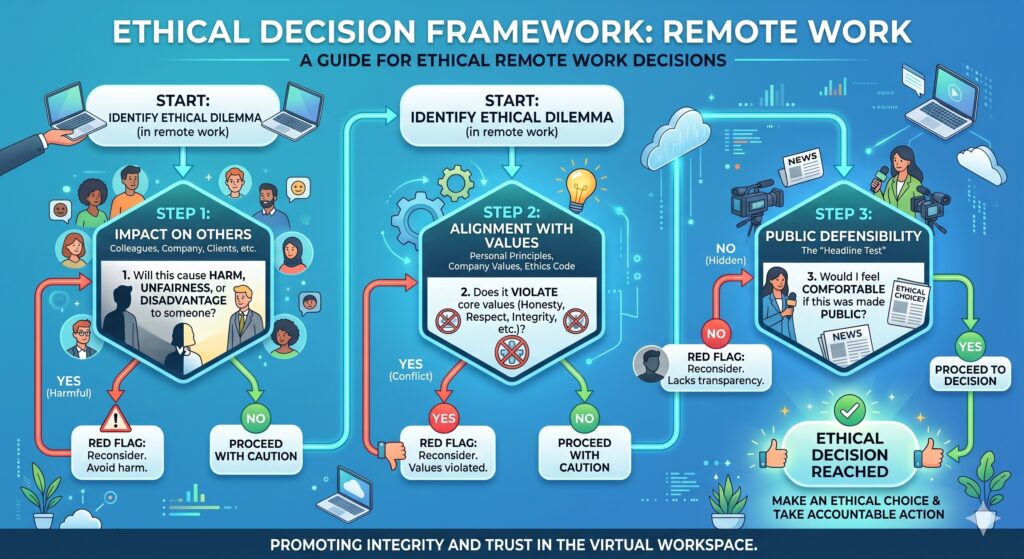
The Challenge: Remote work can create ethical blind spots. It’s easier to overlook how decisions affect people you don’t see daily. Pressure to demonstrate productivity in asynchronous environments might lead to cutting corners or overlooking inclusivity.
Confucian Response: Yi (righteousness) means doing what is right because it is right, not because of consequences or rewards. Zhi (wisdom) gives us the judgment to navigate complex situations. Together, they form the basis for ethical action that isn’t swayed by convenience or bias.
Practical Applications:
- Ethical Decision Frameworks: Adopt simple checks for important choices:
- “Who might be disadvantaged by this decision, and how can we mitigate harm?”
- “Does this align with our stated values, or are we prioritizing convenience over principle?”
- “If this decision were made public, would we be proud to defend it?”
- Inclusive Practices: Apply Confucian attention to hierarchy and voice:
- Actively soliciting input from junior team members before decisions are made
- Rotating facilitation roles in meetings to ensure diverse voices are heard
- Being mindful of time zones when scheduling recurring events
- Transparency as a Form of Respect: Share context behind decisions, especially those affecting workloads or priorities, to help others understand the “why”—a key aspect of treating people as ends in themselves, not means.
This approach prevents remote work from becoming a race to the bottom where ethical considerations are sacrificed for perceived efficiency.
Balancing Structure and Flexibility: The Confucian Middle Way
Confucius advocated for balance—not excessive rigidity, nor chaotic flexibility. He noted that “the wise find pleasure in water; the virtuous find pleasure in mountains” (Analects 6.23), suggesting that different virtues complement each other. Applied to remote work, this means:
- Structure Without Stifling: Clear expectations (li) that enable, rather than hinder, autonomy and creativity.
- Flexibility Without Chaos: Adaptability to individual circumstances (time zones, caregiving responsibilities) while maintaining team cohesion and reliability.
- Tradition and Innovation: Honoring useful practices from co-located work while embracing new possibilities enabled by digital tools.
The goal isn’t to recreate the office online, but to cultivate a remote work culture where people feel connected, respected, and motivated to contribute their best—where virtue is practiced not despite the distance, but through thoughtful adaptation to it.
Conclusion
Confucius didn’t have Zoom or Slack, but he understood something fundamental about human collaboration: it thrives on mutual respect, sincere effort, and attention to the quality of our relationships. The remote work revolution hasn’t changed these fundamentals—it has merely changed the context in which we practice them.
By treating virtual interactions as opportunities to embody ren (benevolence), li (propriety), xiao (loyalty), yi (righteousness), and zhi (wisdom), we can build remote teams that aren’t just productive, but genuinely harmonious and fulfilling. The rituals we create, the relationships we nurture, and the ethical standards we uphold become the true infrastructure of our digital workplaces—far more determinative of success than any particular tool or policy.
In the end, the most successful remote teams won’t be those with the best technology, but those that best embody the Confucian ideal: people showing up for each other with sincerity, respect, and a shared commitment to doing what is right, even when no one is watching.